
Key takeaways
- Build a calm family records desk for home paperwork with a file cabinet, visible daily storage, steady sorting light, and a protective document case.
Every household runs on paper, even the ones that try hard not to. School permission slips land on the counter, insurance letters hide inside grocery flyers, appliance manuals migrate from drawer to drawer, and the one document needed for an appointment is always the one at the bottom of a pile. A family records desk solves this by giving all of that paper a single calm home: one station where mail gets sorted the day it arrives, school papers get filed by child, and important records wait in a known place instead of scattered across the house.
The station does not need to be large or complicated. It needs a real filing core, visible parking for the small daily tools that paperwork involves, light that makes sorting easy on the eyes, a safe way to carry documents out of the house, and one small finishing touch that ties the station to the home it serves. The five picks below build exactly that setup, layer by layer, so paperwork becomes a short, predictable routine instead of a recurring scavenger hunt.
As an Amazon Associate, we earn from qualifying purchases.
Laura Davidson Stockpile File Cabinet

Every records desk starts with a core, and a proper file cabinet is the only piece of furniture that truly earns that role. The Laura Davidson Stockpile file cabinet gives household paperwork a dedicated, structured home instead of a growing stack on the desk surface. Drawers sized for hanging files let each category of family life get its own section: school records in one run of folders, medical and insurance papers in another, home and vehicle documents in a third, and tax-season material in its own separated space.
The rolling design matters more than it first appears. A records station often has to share a room with other duties, and a cabinet on smooth casters can slide out for a deep sorting session and tuck back beside the desk when the room needs to be something else again. The flat top earns its keep as well, serving as the landing pad for the day’s incoming mail before it gets sorted.
What makes a cabinet the right core is the habit it creates. When filing takes ten seconds because the drawer is right there and the folder is labeled, paper gets filed. When filing means carrying a stack to another room, paper piles up. This cabinet keeps the whole archive within arm’s reach of the sorting surface, which is where a family records system either succeeds or quietly falls apart.
Specs
- Mobile file cabinet with smooth-rolling caster wheels
- Drawers sized for letter-size hanging file folders
- Flat top surface usable as a mail landing pad
- Sturdy frame designed for daily household use
- Compact footprint that fits beside most desks
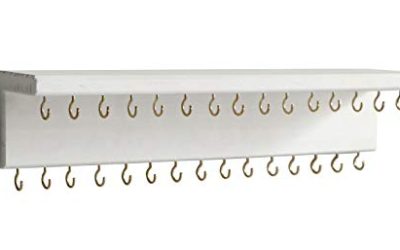
SANY DAYO Jewelry Organizer 30 Hooks

Paperwork involves more small tools than anyone expects: keys to the cabinet and the mailbox, scissors for envelopes, a pen that actually works, reading glasses, charging cables for the phone that holds the scanning app. When those items have no fixed home, every sorting session starts with a search. The SANY DAYO jewelry organizer, with its long rail of hooks, turns out to be a surprisingly natural solution mounted on the wall above the records desk.
Each hook becomes an assigned parking spot. Keys hang in the same place every day, so the mailbox run takes seconds. Scissors, a letter opener, and a lanyard with a USB drive of scanned records all stay visible and reachable instead of buried in a junk drawer. Cables loop neatly over their own hooks, off the desk surface and out of the paper piles. Because everything is visible at a glance, a missing item is obvious immediately, which quietly keeps the whole station honest.
The rail also gives the records desk a boundary. The wall above the desk belongs to the system: hooks for tools, nothing else competing for the space. Family members learn the layout quickly, and even a child can return an item to its hook without understanding the filing system itself.
Specs
- Wall-mounted organizer rail with thirty individual hooks
- Open, visible storage for keys, tools, and cables
- Slim profile that mounts above a desk without crowding it
- Keeps small daily items off the sorting surface
- Simple installation with standard wall hardware
HEKEE Dusk to Dawn Light Bulbs A19

Sorting paperwork is visual work. Reading faded print on a utility statement, telling two similar forms apart, checking the small type on an insurance letter: all of it goes better under steady, adequate light, and worse under a dim lamp someone has to remember to switch on. The HEKEE dusk to dawn bulbs remove the remembering. A built-in light sensor turns them on as the room darkens and off when daylight returns, so the records corner is simply lit whenever anyone sits down to sort.
That automatic behavior suits a paperwork station well because paperwork rarely happens on a schedule. Mail gets sorted at dusk after work, school forms get signed in the evening, and a weekend archiving session drifts later than planned. In every case the light is already there, even and unglamorous, without a hand hunting for a switch. Consistent light also helps when scanning or photographing documents, since the page is lit the same way every time and phone cameras produce cleaner, more readable captures.
Fit the bulbs into the lamp or fixture that serves the desk, and the lighting layer of the station quietly takes care of itself from then on.
Specs
- Standard A19 bulb shape fits most lamps and fixtures
- Built-in dusk to dawn sensor for automatic on and off
- Energy-efficient LED design for long daily run times
- Even, steady light suited to reading and sorting tasks
- No timers, apps, or switches to manage
tomtoc Laptop Case

A family records system has to leave the house sometimes. School enrollment needs original documents, a passport appointment needs the full folder, a meeting with an accountant means carrying a year of paperwork across town. The tomtoc laptop case, built as a structured, padded carrier, doubles naturally as the records desk’s travel arm: a protective sleeve that holds a laptop or tablet alongside the flat documents those appointments revolve around.
The structure is the point. Loose papers in a tote bag arrive creased and shuffled; papers in a rigid, padded case arrive flat, ordered, and presentable. Internal organization keeps the device, its cable, and a slim folder of documents separated, so the folder can be pulled out without unpacking the whole bag. After the appointment, the case comes home and parks beside the cabinet, and the documents go straight back into their folders while the trip is still fresh in mind.
The case also protects the digital half of the records system. Many families keep scanned copies of everything on a laptop or an external drive, and that device deserves the same care as the paper archive. A padded, water-resistant shell guards it on school runs and office visits. Paper core at home, protected carrier on the road: together they cover the full life of a family’s documents.
Specs
- Structured, padded shell that keeps contents flat and protected
- Sized for a laptop or tablet plus slim document folders
- Internal pockets for cables and small accessories
- Water-resistant outer material for everyday travel
- Carry handle for appointments and school runs
OLADOT Floating House Number 5 Inch

The last pick is the smallest, and it works on the outside of the home rather than at the desk itself. The OLADOT floating house number is a plain, modern address marker: a clean sign shape that mounts with a floating effect, standing slightly off the wall so it casts a subtle shadow and reads as a deliberate design detail rather than an afterthought. In this setup it is described simply as the home’s address marker, a plain sign form chosen to match the style of the house.
Its connection to the records desk is practical. A surprising share of household paperwork problems begin at the front door: deliveries left at the wrong house, a replacement card or official letter that never arrives, a courier who cannot find the address and leaves. A clear, visible address marker reduces those misses, which means the mail the records system depends on actually reaches the mailbox, and fewer sorting sessions start with a missing envelope.
As a finishing touch, the sign also gives the whole paperwork project a sense of completion. The station inside is organized, and the marker outside quietly announces a household that keeps its details in order. Choose the character that matches the home, mount it where it catches the light near the entry, and let it do its simple job every day without any upkeep at all.
Specs
- Floating mount design that stands off the wall surface
- Plain, modern sign shape with a clean generic finish
- Weather-resistant construction for outdoor mounting
- Visible from the street for couriers and visitors
- Simple installation with standard mounting hardware
How to Choose
Start with the filing core, because every other choice depends on it. Count the categories of paper the household actually keeps, and make sure the cabinet has room for each one plus a year of growth. A records system that is full on day one will overflow by spring, so spare drawer space is a feature, not waste.
Next, give the daily tools a visible home. Walk through a typical mail day and list everything touched: keys, opener, pen, glasses, phone cable. If each item has an assigned hook or spot within reach of the chair, sorting stays a two-minute habit. If anything on that list lives in another room, the habit will break, so fix the wall storage before blaming the routine.
Then sort out the light and the travel layer. Paperwork happens at odd hours, so favor light that turns itself on, placed so no shadow falls across the page. Pick one case that always serves as the document carrier and keep it parked at the desk, so leaving for an appointment is a grab, not a gathering exercise. Finally, look at the front of the house: a legible address marker protects the whole system at its entry point, making sure the mail the desk exists to organize actually arrives.
Frequently Asked Questions
Where is the best place in the home for a family records desk?
A spot near the entry the mail comes through works best, because paper gets sorted before it spreads. A hallway corner, part of the living room, or a shared home office all work, as long as the cabinet, wall storage, and light live together in one place.
How should folders be organized inside the cabinet?
Group by area of life rather than by document type: one section per child for school and medical papers, one for the home, one for vehicles, and one for money and tax material. Broad categories that match how the family thinks are easier to maintain than a clever scheme nobody remembers.
Does a records desk still make sense for a household going paperless?
Yes, because the transition itself generates paper, and some originals, certificates, deeds, and signed forms, should always be kept in physical form. The desk becomes the scanning station: paper arrives, gets scanned, and is filed or recycled the same day, with the case carrying originals when an appointment requires them.
How often should the records be reviewed and thinned out?
Once a year is enough for most households, ideally at tax season when the money folders are already open. Shred expired statements and outdated duplicates, move long-term records to the back of the drawer, and leave the front sections light and easy to file into.
Final Verdict
A family records desk succeeds when it removes decisions: paper arrives, and everyone in the house already knows where it goes. The Laura Davidson Stockpile file cabinet anchors the system with real, rolling storage. The SANY DAYO hook rail keeps the small tools of paperwork visible and parked. The HEKEE dusk to dawn bulbs keep the corner lit whenever a sorting session happens, with nothing to switch or schedule. The tomtoc case carries documents and the family laptop to appointments and back without creases or chaos. And the OLADOT floating house number, a plain address marker at the front of the home, protects the system where it starts, at the mailbox. Together, these five picks turn scattered household paperwork into one calm, repeatable routine.
Product and ASIN Reference
| Product | ASIN |
|---|---|
| Laura Davidson Stockpile file cabinet | B0BKYJY5Q4 |
| SANY DAYO jewelry organizer 30 hooks | B07QFZSVQW |
| HEKEE dusk to dawn light bulbs A19 | B07HGZMYZ4 |
| tomtoc laptop case | B073TVX735 |
| OLADOT floating house number 5 inch | B09JFQC5W2 |
FAQ
Where is the best place in the home for a family records desk?
How should folders be organized inside the cabinet?
Does a records desk still make sense for a household going paperless?
How often should the records be reviewed and thinned out?
More from Amazon
Programs that pair well with the guide above. Offers and eligibility are set by Amazon and may change.
Free shipping on eligible items, Prime Video and more. Eligible new members can start with a free trial.
Start a Prime free trialAudiobooks and podcasts to listen to on the go. Eligible new members can start with a free trial.
Try Audible freeAd-free music streaming. Eligible new subscribers can start with a free trial.
Try Music Unlimited freeA free business account with business pricing and bulk-buying tools for work, shop or home office.
Create a business accountAs an Amazon Associate we earn from qualifying purchases.









Write Your Review
No reviews yet. Be the first to share your experience!