
Key takeaways
- Build a calm archive desk for a family photo library: five picks for clean wireless scanning, print and drive storage, backup rotation, and gentle light.
Every family has the boxes. Prints curling in a closet, slides in a carousel nobody can project anymore, a drawer of external drives labeled in handwriting that made sense a decade ago. Turning that pile into a real family photo library is not a weekend project; it is a slow, satisfying habit, and it works far better at one dedicated corner instead of wherever a laptop happens to land. An archive desk gives the project a permanent home: the scanner stays plugged in, the current box stays in reach, and finished material leaves the surface the moment it is labeled and stored.
This guide rounds up five picks that support the four jobs an archive desk has to do well. First, the wireless link between scanner, computer, and storage has to stay clean, because large scan files moving over a flaky connection waste entire evenings. Second, prints, albums, and drives need a proper archive home, not a growing stack. Third, the backup rotation has to be simple enough to actually happen, including the copy that lives away from the house. Fourth, the small tools of the trade need fixed places, and the corner needs gentle light for the long, pleasant sessions of sorting and naming.
As an Amazon Associate, we earn from qualifying purchases.
Seesii TinySA Ultra Spectrum Analyzer: A Clean Wireless Corner for Scanning

Scanning is patient work, but the file transfers behind it are not forgiving. A scanner sending large files to a computer, and that computer syncing the results to a network drive, depends on a wireless environment that stays predictable for hours at a time. When transfers stall or a scanner drops off the network mid-batch, the usual suspects are invisible: a crowded channel, a neighboring network overlapping the home one, or a household device spraying interference across the band the archive corner relies on. The Seesii TinySA Ultra spectrum analyzer makes that invisible layer visible, so the scanning corner can be set up on evidence instead of guesswork.
Before the desk is even arranged, a slow sweep of the room shows which channels are busy and which are quiet, and that single observation decides which band the scanner and computer should prefer. During long sessions, a quick check explains the otherwise mysterious slow evening: a new device has appeared on the same channel, and a channel change restores the pace. For an archive project measured in months, that clarity keeps the workflow boring in the best possible way, because the technology stops being the story and the photographs get to be.
Specs
- Handheld spectrum analyzer with a color display
- Wide frequency coverage for common household wireless bands
- Signal generator function built in
- Rechargeable battery for room-by-room surveys
- Compact body that stores in a desk drawer
Laura Davidson Stockpile File Cabinet: The Archive Itself, in Drawers

Digitizing is only half the job. The originals still need a home that respects them, and the drives holding the growing library need one too. The Laura Davidson Stockpile file cabinet gives the archive desk its foundation: a proper, closed, organized place where finished boxes of prints, labeled albums, and backup drives live in drawers instead of migrating around the house. A cabinet beside the desk turns the workflow into a one-way street. Material arrives in the inbox box, gets scanned and labeled, and then moves into a drawer organized by decade or by branch of the family, never to pile up again.
The drawer format suits archive material unusually well. Prints and albums stand or lie in labeled groups that can be thumbed through like a card catalog, and a simple divider system keeps the order honest. One drawer can hold the physical originals, another the working drives and memory cards awaiting their turn in the backup rotation, and a third the supplies: archival sleeves, cotton gloves for handling fragile prints, labels, and a notebook logging what has been scanned. Because the cabinet closes, the corner also looks like furniture rather than a project explosion, which matters for a desk that lives in a shared room for months.
Specs
- Steel file cabinet with smooth-gliding drawers
- Sized for letter and legal documents and media storage
- Locking drawer for valuables and master drives
- Compact footprint that fits beside a desk
- Neutral finish suited to home rooms
tomtoc Laptop Case: The Off-Site Backup Rotation, Made Portable

A library that exists in only one building is one accident away from being a memory. The standard answer is a rotation, where one backup drive lives off site, at a relative’s home or a workplace drawer, and the copies swap on a regular rhythm. The tomtoc laptop case is what makes that rhythm realistic. It protects the laptop and the rotation drive on the trip between houses, turning a fragile errand into a simple habit that fits into a visit that was happening anyway.
The case earns its place at the archive desk between trips as well. It is the designated parking spot for the drive currently waiting to travel, so the rotation copy is never mixed up with the working drives in the cabinet, a confusion that quietly defeats the whole system. Its structured padding suits the way archive gear actually travels: laptop, one or two drives, a cable, and the scanning log. When the swap happens monthly, or after every major scanning milestone, the library quietly gains the property that matters most for a family treasure: it can survive the house it was made in.
Specs
- Padded laptop case with structured protection
- Interior pockets for drives, cables, and accessories
- Water-repellent outer fabric
- Carry handle and shoulder-friendly design
- Sized for everyday laptops and their archive kit
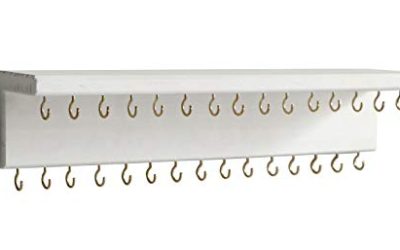
SANY DAYO Jewelry Organizer 30 Hooks: A Rail for Cables, Labels, and Small Tools

An archive desk accumulates small things at an impressive rate: the scanner’s power lead, two kinds of USB cable, the card reader, a loupe for checking prints, scissors, label strips, and the little brush that keeps the scanner glass honest. Left loose, they form the classic tangle that makes starting a session feel like work. The SANY DAYO jewelry organizer, a rail with thirty hooks, moves all of it onto the wall in plain sight. Every cable hangs in its own loop, the reader parks on its hook, and the label supplies hang ready for the moment a batch is finished and needs naming.
The hook rail also enforces the archive desk’s best rule: nothing lives on the surface that is not being worked on right now. Prints are delicate, scanner glass is unforgiving of grit, and a clear surface keeps both safe. With the tools vertical and visible, the end-of-session reset takes a minute: cables up, tools up, current box closed, surface empty. The rail’s original purpose, keeping necklaces untangled and visible, translates perfectly, because archive cables have exactly the same habits as jewelry chains.
Specs
- Wall-mounted rail with 30 hooks
- Open-hook design for quick grab and return
- Suited to cables, readers, and small hand tools
- Keeps the work surface completely clear
- Simple mounting for a wall or cabinet side
HEKEE Dusk to Dawn Light Bulbs A19: Gentle Automatic Light for Evening Sorting

Archive work tends to happen in the evening, in the hour when the house quiets down and a box of photographs is better company than a screen full of news. That hour deserves light that is gentle, steady, and thoughtless. The HEKEE dusk to dawn bulbs handle the thinking themselves: a built-in sensor brings the corner’s lamp on as daylight fades and turns it off in the morning, so the archive corner is always softly lit when a session begins and never left burning all day by accident.
Sorting and naming prints is eye work at close range, reading handwriting on the backs of photographs, checking faces, comparing dates. A consistent ambient light that arrives gradually with the dusk is kinder for that work than a harsh lamp snapped on in a dark room, and it keeps colors honest enough for judging whether a print has faded. There is also a quieter benefit: a corner that glows gently every evening is a corner that invites use. The library grows in those unplanned twenty-minute sessions, a handful of prints scanned while dinner finishes, and automatic light makes dropping in effortless.
Specs
- A19 bulbs with built-in dusk to dawn sensor
- Automatic on at dusk and off at dawn
- Standard screw base for common lamps and fixtures
- Even, comfortable light for close sorting work
- No timers, apps, or switches to manage
How to Choose
Start with the flow, not the furniture. An archive desk works when material moves in one direction: unsorted box in, scanning at the surface, labeled originals into the cabinet, files onto the working drive, and the rotation copy out of the house on schedule. Arrange every pick around that path.
Check the wireless environment before blaming the scanner. A spectrum survey takes minutes and settles questions that guessing never will: the best band for the corner, the quietest channel, and the direction the desk should face. Repeat the check whenever a new gadget joins the household network.
Give originals and drives separate, labeled homes. The cabinet’s drawers should answer, at a glance, what is scanned, what is waiting, and where the master copies live. Label by decade or family branch, and keep a simple paper log of progress. Organization that depends on memory fails by the third box; organization that depends on labels does not.
Make the backup rotation boring. One drive in the cabinet, one drive off site, one case that carries the swap, and a fixed trigger, the first weekend of the month or the end of each box. The best backup system is not the cleverest one; it is the one that still happens in month six.
Finally, protect the surface and the light. Tools on hooks, cables on the rail, nothing stored on the desk itself, and gentle automatic light that makes evening sessions easy to start. An archive desk should feel calm every time it is approached, because calm is what a multi-month labor of love runs on.
FAQ
How much space does a family photo archive desk need?
A small desk or table in a quiet corner is enough. The workflow is compact: a scanner, a laptop, one working box, a cabinet beside the desk for originals and drives, and a hook rail on the wall for cables and tools. Because finished material leaves the surface immediately, the footprint stays modest even when the collection is large.
Should original prints be kept after scanning?
Yes. A scan is a working copy and a sharing copy, but the original print remains the most durable version of the photograph and often carries handwriting, dates, and context on its back. Store originals in labeled drawers, grouped the same way as the digital folders, and note in the log where each batch lives so the two libraries mirror each other.
How often should the off-site backup be swapped?
A fixed, simple rhythm works best: monthly, or whenever a major batch is finished, whichever comes first. The case makes the swap a small errand rather than a production. Between swaps, the rotation drive waits in its designated spot, separate from the working drives, so the newest copy is never confused with an older one.
What light is best for sorting and checking old prints?
Steady, even, comfortable light that does not shift during the session. Automatic dusk to dawn bulbs suit evening archive work well because the corner is lit consistently from the moment a session starts, making it easier to judge fading, yellowing, and handwriting on print backs. Avoid strong colored light in the corner, since it distorts the tones being checked.
Final Verdict
A family photo library gets built the way it gets enjoyed: slowly, together, one box at a time. The five picks in this guide give that process a proper home. The Seesii TinySA Ultra keeps the scanning corner’s wireless link clean, the Laura Davidson Stockpile cabinet gives originals and drives a labeled archive of their own, and the tomtoc case turns the off-site backup rotation into a habit that actually happens. The SANY DAYO hook rail keeps cables, labels, and small tools visible and off the delicate work surface, while the HEKEE dusk to dawn bulbs make every evening session begin in gentle, automatic light. Set the corner up once, keep the flow one-directional, and the boxes in the closet become a library the whole family can browse.
Product and ASIN Reference
| Product | ASIN |
|---|---|
| Seesii TinySA Ultra spectrum analyzer | B0BBGK9QJB |
| Laura Davidson Stockpile file cabinet | B0BKYJY5Q4 |
| tomtoc laptop case | B073TVX735 |
| SANY DAYO jewelry organizer 30 hooks | B07QFZSVQW |
| HEKEE dusk to dawn light bulbs A19 | B07HGZMYZ4 |
FAQ
How much space does a family photo archive desk need?
Should original prints be kept after scanning?
How often should the off-site backup be swapped?
What light is best for sorting and checking old prints?
More from Amazon
Programs that pair well with the guide above. Offers and eligibility are set by Amazon and may change.
Free shipping on eligible items, Prime Video and more. Eligible new members can start with a free trial.
Start a Prime free trialAudiobooks and podcasts to listen to on the go. Eligible new members can start with a free trial.
Try Audible freeAd-free music streaming. Eligible new subscribers can start with a free trial.
Try Music Unlimited freeA free business account with business pricing and bulk-buying tools for work, shop or home office.
Create a business accountAs an Amazon Associate we earn from qualifying purchases.









Write Your Review
No reviews yet. Be the first to share your experience!