
Key takeaways
- Set up a small shoe care and repair bench with a tool rail, clamp light, sensor bulbs, a step stool, and a tablet case, plus honest home repair limits.
A small corner of a workshop or garage can handle most everyday shoe care: brushing off road grit, working polish into leather, swapping worn laces, gluing a loose heel cap back down, and keeping notes on which pair needs what. The work is simple, but it goes badly when brushes roll under the bench, polish tins hide behind paint cans, and the only light comes from a dim ceiling fixture across the room. A dedicated bench corner fixes that by giving every brush, cloth, and lace bundle a fixed parking spot in the order the work happens.
This guide pulls together five practical picks: a wall rail that keeps brushes and cloths off the bench surface, a clamp that holds a bench light at one steady angle, sensor bulbs for the room’s general light, a step stool for the high shelf, and a padded case for the tablet holding care notes. One honest boundary runs through everything below: cleaning and simple care should always follow each product’s own printed directions, and structural repairs — resoles, separated welts, cracked shanks, torn uppers — belong to a cobbler. A tidy bench makes routine care easier; it does not turn a home corner into a repair shop.
As an Amazon Associate, we earn from qualifying purchases.
SANY DAYO Jewelry Organizer With 30 Hooks

The first problem at any small bench is surface clutter. Brushes, polishing cloths, spare lace bundles, and a small notebook all compete for the same square foot of bench, and the item needed next is always the one buried. The SANY DAYO organizer answers that with a wall-mounted rail of thirty hooks: brushes hang by their handles in a row, cloths fold over hooks of their own, and lace bundles loop onto the end hooks, untangled and visible. Parking tools in use order — cleaning brush first, then applicator, then shine cloth — turns a care session into a left-to-right walk along the rail instead of a search.
Honesty matters here, because this product is a jewelry organizer by design, built for light duty. Necklaces and bracelets are its intended load, so the hooks suit brushes, cloths, laces, and other featherweight items. Heavy jars of leather balm and polish tins in quantity belong on the bench or a shelf, not on these hooks. Mounted at eye height beside the bench, the rail keeps the work surface clear for the shoe itself: the shoe gets the bench, the tools get the wall.
Specs
- Wall-mounted organizer with 30 hooks in a single rail layout
- Designed for jewelry; repurposed here as a light-duty tool rail
- Suited to brushes, cloths, lace bundles, and other lightweight items
- Frees bench surface by moving small tools to vertical storage
- Best mounted within arm’s reach of the main work position
ULANZI Super Clamp

Close work needs light aimed at the shoe, not at the ceiling. The ULANZI super clamp grips the edge of a bench, shelf, or nearby post and holds a small bench light at a fixed angle, so stitching, scuffs, and polish coverage stay visible from the same direction every session. A fixed angle matters: when the light never moves, a dull patch reads the same way each time, and comparisons between sessions stay honest.
The clamp deserves a plain description: it is a mount, and only a mount. It includes no light, no bulb, and no lamp head of its own, so it pairs with a small light the bench already owns or one bought separately. Its grip is its whole job — a padded jaw that bites onto an edge and stays put while hands work below it. Positioned on the bench edge opposite the dominant hand, it keeps the light out of the elbow zone while raking across the shoe’s surface, the angle that reveals texture, cracks, and uneven polish best.
Specs
- Clamp-style mount for attaching a small light to a bench edge or shelf
- Mount only: no light, bulb, or lamp included
- Adjustable positioning for a fixed, repeatable lighting angle
- Padded jaw helps grip without marring the mounting surface
- Suits small lights and other lightweight accessories within its grip range
HEKEE Dusk to Dawn Bulbs A19

General room light is a separate job from inspection light, and the HEKEE bulbs handle the first one automatically. Each A19 bulb carries a dusk-to-dawn sensor: it switches on when ambient light falls and off when daylight returns, so the corner is never fully dark when someone walks in carrying a pair of boots. For a corner used in short, irregular sessions, that removes the fumble for a switch with full hands.
Two honest caveats come with these bulbs. First, they are plain sensor bulbs, not smart bulbs — no app control, no dimming schedule, no color adjustment, just a sensor and a switch. Second, they are not the inspection light for close work; judging polish color or spotting a hairline crack still needs the dedicated bench light above. And one behavior surprises people: in a closed workshop with no windows, the sensor may read the room as dusk all day and keep the bulbs on during daytime hours. That is the sensor doing its job with the information it has; in a windowless room the bulbs simply behave like ordinary light whenever the room is dark.
Specs
- A19 bulbs with a built-in dusk-to-dawn light sensor
- Automatic on at low light and off when ambient light returns
- Plain sensor bulbs: not smart bulbs, no app or voice control
- Standard base for common workshop and garage fixtures
- Intended for general room light, not close inspection work
Rubbermaid 2-Step Plastic Step Stool
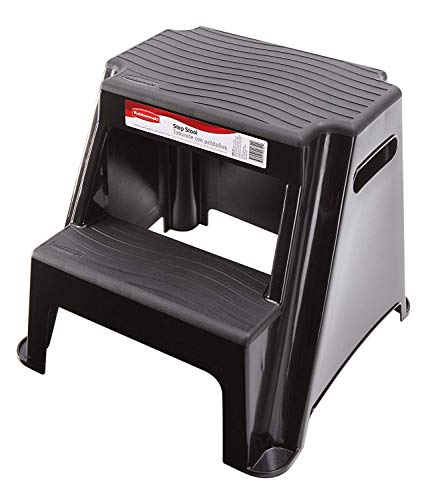
Shoe care supplies multiply quietly: extra polish colors for different leathers, a second set of brushes, spare insoles, replacement heels. In a small corner, that overflow ends up on a high shelf, and reaching it by standing on a chair or the bench edge is how small workshops produce big falls. The Rubbermaid two-step stool is the unglamorous pick that prevents that — a molded plastic step that puts the high shelf within normal reach.
Its role needs the same plain framing. This is an adult reach tool: a step for a grown person retrieving a light box or tin from a shelf. It is not seating, not a work platform to stand on while repairing a shoe at height, and not a step to use with wet or polish-slick soles. The treads should be wiped dry before use, because a workshop floor and a plastic tread are a slippery pairing after any spill. Stored against the wall beside the bench, it takes almost no floor space.
Specs
- Two-step molded plastic stool for reaching high shelves
- Adult reach tool for light retrieval tasks
- Lightweight and easy to move or store against a wall
- Treads should be kept clean and dry before stepping up
- Not intended as seating or as a standing work platform
tomtoc Laptop Case

A tablet or slim laptop earns a place at a shoe bench for unglamorous reasons: care notes live there — which polish went on which leather, when a pair was last conditioned, which product directions warned against use on suede. Having those directions readable at the bench, straight from the maker’s page, beats guessing. The tomtoc case protects that device between sessions, because a workshop corner is hostile to a screen: grit on every surface and tools sliding around.
The case is a padded soft case, and its limits should be stated as plainly as its strengths. Padding guards against bumps, scratches, and casual knocks in a drawer or on a shelf; it is not a hard shell, it makes no promise about a drop from the bench onto concrete, and it is not waterproof, so a spilled tin or wet cloth is still a threat if the case sits open nearby. Fit matters too: internal dimensions vary by model, so measure the tablet or laptop against the case’s stated interior size before ordering. Closed and shelved after each session, it keeps the notes device clean and the bench returns to being a bench.
Specs
- Padded soft case for a tablet or slim laptop
- Protects against bumps and scratches during storage and short carries
- Soft construction: not a hard shell and not waterproof
- Sized models vary; check internal dimensions against the device
- Keeps care notes and product directions available at the bench
How to Choose
Start with the workflow, not the shopping list. A shoe care session runs in a fixed order — brush off grit, clean, condition or polish, rest, then lace and inspect — and the corner works when every item sits where that order reaches for it. The wall rail holds the tools in sequence, the clamp light rakes across the bench from the side opposite the working hand, and overflow storage stays reachable without crossing the room. Any pick that does not serve that order is decoration.
Match each item to its honest job. Light-duty storage is fine for brushes and cloths but wrong for heavy tins; sensor bulbs are right for general room light but wrong for judging color or cracks; a soft case is right for shelving a tablet but wrong as drop protection on concrete. Most disappointment with bench gear comes from asking a product to do a different product’s job.
Respect the repair boundary. Home care handles cleaning, conditioning, polishing, lace replacement, and minor glue work such as a loose heel cap, always following the care product’s own directions for the material at hand. Anything structural — a sole separating along its length, a cracked shank, stitching letting go, an upper tearing at a stress point — is cobbler’s work, and attempting it with home adhesives usually makes the professional repair harder.
Finally, measure the corner before ordering anything. Rail length against the wall space, clamp grip against the bench edge thickness, bulb base against the fixture, case interior against the device: four quick measurements decide whether the picks fit the corner that actually exists.
FAQ
What shoe repairs can a home bench corner realistically handle?
Routine care is the realistic scope: brushing, cleaning, conditioning, polishing, replacing laces, and small glue jobs such as reattaching a loose heel cap, each done by following the care product’s own directions for that material. Structural work — resoles, welt stitching, shank or sole replacement, torn uppers — belongs to a cobbler with the presses, lasts, and adhesives the job requires.
Can the hook rail hold polish tins and jars?
No, and it is not meant to. The rail is a jewelry organizer with a light-duty design, suited to brushes, cloths, and lace bundles. Tins and jars carry real weight in a small footprint and belong on the bench or a shelf. Keeping heavy items off the hooks is what keeps the rail reliable for the light tools it holds well.
Why use sensor bulbs if a bench light is still needed?
They do different jobs. The sensor bulbs provide automatic general light so the corner is usable the moment someone walks in, with no switch to find. Judging polish color, spotting cracks, and checking coverage need a steady, directional light at close range, which is the clamped bench light’s role. One handles the room; the other handles the shoe.
How should care notes be organized on the tablet?
A simple note per pair works best: the material, the products used, the date of the last session, and anything to watch, such as a heel wearing unevenly. Keeping the maker’s directions saved alongside the note prevents the most common mistake — using a product on a material its directions exclude.
Final Verdict
A shoe care corner succeeds on order and honesty: tools parked in the sequence the work uses them, light split between an automatic room layer and a fixed inspection angle, overflow supplies reached safely, and notes protected between sessions. The SANY DAYO rail clears the bench by taking brushes, cloths, and laces to the wall within its light-duty limits. The ULANZI clamp holds a bench light at the angle that makes wear and coverage easy to judge. The HEKEE bulbs keep general light automatic. The Rubbermaid stool turns the high shelf into a safe reach, and the tomtoc case keeps the notes tablet padded and clean in a gritty room. None of these picks repairs a shoe by itself, and that is the right expectation: they make routine care — done by each product’s own directions — easier to start and repeat, while structural repairs stay where they belong, with a cobbler.
Product and ASIN Reference
| Product | ASIN |
|---|---|
| SANY DAYO jewelry organizer 30 hooks | B07QFZSVQW |
| ULANZI super clamp | B09C882D4M |
| HEKEE dusk to dawn bulbs A19 | B07HGZMYZ4 |
| Rubbermaid 2-step plastic step stool | B004Q0I2RS |
| tomtoc laptop case | B073TVX735 |
FAQ
What shoe repairs can a home bench corner realistically handle?
Can the hook rail hold polish tins and jars?
Why use sensor bulbs if a bench light is still needed?
How should care notes be organized on the tablet?
More from Amazon
Programs that pair well with the guide above. Offers and eligibility are set by Amazon and may change.
Free shipping on eligible items, Prime Video and more. Eligible new members can start with a free trial.
Start a Prime free trialAudiobooks and podcasts to listen to on the go. Eligible new members can start with a free trial.
Try Audible freeAd-free music streaming. Eligible new subscribers can start with a free trial.
Try Music Unlimited freeA free business account with business pricing and bulk-buying tools for work, shop or home office.
Create a business accountAs an Amazon Associate we earn from qualifying purchases.










Write Your Review
No reviews yet. Be the first to share your experience!