
Key takeaways
- Compare the best office chair cushions for desk work, from gel memory foam to a polymer grid, with honest notes on height, firmness and foam lifespan.
Disclosure: As an Amazon Associate, I earn from qualifying purchases.
If your chair felt fine for the first month and now leaves your tailbone or hips aching by mid-afternoon, a seat cushion is the simplest part of the setup to change. A good cushion redistributes pressure away from your sit bones and can rescue a hard dining chair pressed into service as office furniture.
But a cushion is a patch, not a cure. It cannot fix a chair with a broken tilt mechanism, a seat that is the wrong depth for your legs, or missing lumbar support. It also changes your sitting height, which affects your desk, armrest and monitor geometry. This guide compares five well-known office chair cushions across the main design families — U-shaped memory foam, dense contoured foam, a polymer grid and classic TEMPUR foam — with each design’s trade-offs stated plainly.
How to Choose an Office Chair Cushion
Start with shape. The two main families are cutout cushions and contoured cushions. A U-shaped cutout at the rear suspends your tailbone so it carries almost no load, which is why people with coccyx soreness gravitate to them. A contoured cushion has no hole; instead it spreads pressure across your hips and thighs. If your discomfort is specifically at the tailbone, a cutout is the more direct answer. If your chair seat is simply hard and flat, a contour usually feels more stable.
Check the fill. Standard memory foam is soft but compresses permanently over time. Gel-infused foam adds a layer meant to reduce heat build-up, though the effect is modest. Extra-dense foam resists bottoming out and suits heavier sitters, at the cost of a firmer first impression. A polymer grid, like Purple’s, does not flatten the way foam does and lets air pass through, but it is thinner and heavier. TEMPUR material is a denser, slower-rebound memory foam that molds closely and firms up in cold rooms.
Measure your chair seat. Most cushions are roughly 17 to 18 inches wide and 14 to 16 inches deep. If the cushion is deeper than your chair seat, it pushes you forward and changes how your knees bend. If it is much narrower, you will feel the edges. Measure the flat part of your seat, not the full frame.
Respect the height change. A cushion adds its full thickness to your seat height — anywhere from about 1.5 to 4 inches in this group. That raises your eye line and elbows and can leave your feet dangling if your chair is already at its lowest setting. Before buying a thick cushion, raise your chair by a similar amount and work for an hour to check the fit.
Be honest about lifespan. Memory foam softens with months of daily use; a cushion that feels supportive in January may feel noticeably flatter by autumn, especially under heavier users. Higher-density foam slows this down but does not stop it. Treat a foam cushion as a consumable you may replace every year or two. A washable cover and a non-slip base make daily use easier.
ComfiLife Gel Enhanced Seat Cushion

Specs
- Fill: gel-infused memory foam
- Shape: U-shaped coccyx cutout with contoured front edge
- Size: 17.6 x 13.8 x 2.75 inches
- Cover: removable, machine-washable velour
- Base: non-slip rubberized bottom, built-in carry handle
The ComfiLife is the reference design for this category: a gel-topped memory foam cushion with a deep U-cutout that leaves the tailbone floating. The gel layer does not make it cool all day, but it takes the edge off the heat build-up plain memory foam is known for. The non-slip base matters on leather and mesh chairs, and the handle makes it easy to carry between a desk chair and a car seat.
Its limits are size and firmness. At 13.8 inches deep it is one of the shortest cushions here, so taller users on deep seats may find their thighs under-supported. It is medium-firm by design — supportive rather than plush — and like all foam in this class it will gradually soften.
Pros:
– Cutout directly unloads the tailbone
– Washable cover and non-slip base are easy to live with
– Portable enough to move between office, car and home
Cons:
– Short depth suits compact chairs better than deep seats
– Medium-firm feel disappoints anyone expecting a soft pad
– Foam softens over months of daily use
Who it suits: Desk workers whose main complaint is tailbone soreness, and anyone who wants one cushion to share between an office chair and a car.
Cushion Lab Pressure Relief Seat Cushion
Specs
- Fill: extra-dense memory foam, charcoal-infused
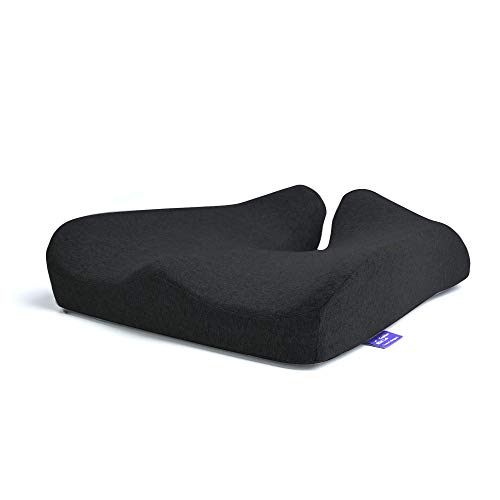
- Shape: patented contour with raised rear and leg channels, no cutout
- Size: approximately 17.7 x 15 x 4 inches
- Cover: removable and washable
- Foam certification: CertiPUR-US certified foam
Cushion Lab takes the opposite approach to ComfiLife: no hole, just a thick slab of extra-dense foam sculpted so your weight spreads across your hips and thighs instead of concentrating on two points. The density is the story — this is the cushion in the group least likely to let a heavier sitter bottom out onto the chair beneath.
The trade-off is height. At roughly 4 inches thick it adds more seat height than anything else here, which can wreck a carefully set desk height or leave shorter users’ feet off the floor. It is also genuinely firm for the first week or two.
Pros:
– Dense foam resists bottoming out under heavier users
– Contour spreads pressure without a cutout
– Thick profile rescues low, flat, worn-out chair seats
Cons:
– Adds about 4 inches of seat height — check your desk geometry first
– Firm feel takes adjustment
– No cutout, so tailbone relief is indirect
Who it suits: Heavier sitters, and anyone whose chair seat has gone flat and hard, provided the desk setup can absorb the extra height.
Everlasting Comfort Seat Cushion

Specs
- Fill: 100 percent memory foam
- Shape: U-shaped coccyx cutout with contoured surface
- Size: 17.5 x 13.5 inches (Large), about 2.75 inches thick
- Cover: removable, machine-washable
- Base: non-slip bottom
The Everlasting Comfort cushion is the long-running straightforward option: pure memory foam, a U-cutout, a washable cover and a grippy base, with no gel layer or sculpting claims. Its initial feel is softer than the ComfiLife, which some people prefer for shorter sessions and lighter body weights, and the shape works on office chairs, car seats and stadium seating alike.
The honest caveat is durability of feel. This style of cushion commonly loses its spring after months of all-day use, and lighter, softer foam flattens faster under heavier users. There is also no gel or ventilation, so it can feel warm in summer.
Pros:
– Simple, proven cutout design
– Softer initial feel than firmer rivals
– Washable cover and non-slip base included
Cons:
– Foam flattens comparatively quickly under daily all-day use
– No cooling layer; can feel warm
– Thinner support than dense contoured models for heavy users
Who it suits: Lighter users and part-time desk workers who want the classic cutout design without a firm break-in period.
Purple Double Seat Cushion
Specs
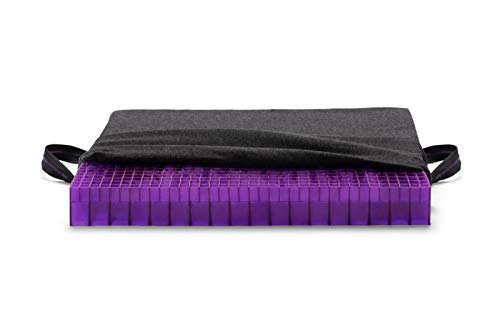
- Material: GelFlex Grid hyper-elastic polymer, dual-sided (one firmer side, one softer side)
- Size: 18 x 15.5 x 1.6 inches
- Cover: washable cover with non-slip base included
- Airflow: open grid structure
- Weight: noticeably heavier than foam cushions of similar size
Purple’s cushion is not foam at all. It is a grid of flexible polymer walls that buckle under your sit bones and spring back everywhere else. Two properties follow. First, it does not take a permanent set the way memory foam does, so its support does not fade month by month. Second, air flows straight through it, making it the coolest-sitting option here by a wide margin.
The compromises are thickness and feel. At 1.6 inches it adds little padding over a truly hard seat and little height — good for desk geometry, less good if you wanted a boost. It is heavy to carry, and the grid sensation through thin clothing is unusual enough that some people never get used to it.
Pros:
– Grid does not flatten like foam over time
– Best airflow in this group; sits cool
– Two firmness levels in one cushion
Cons:
– Thin profile adds limited padding and height
– Heavy for something you might carry daily
– Grid feel is not for everyone
Who it suits: People who run hot, hate replacing flattened foam cushions, and sit on firm chairs that need pressure relief more than padding.
Tempur-Pedic Seat Cushion

Specs
- Fill: TEMPUR proprietary viscoelastic memory foam
- Shape: contoured seat, no cutout
- Size: Medium, approximately 16.5 x 16.5 x 2.5 inches
- Cover: removable, allergen-resistant, washable
- Origin: made in the USA
The Tempur-Pedic entry uses the company’s TEMPUR material, a denser and slower-rebounding foam than generic memory foam. It molds closely and distributes pressure very evenly. The moderate 2.5-inch profile adds support without drastically changing your sitting height, and the cover is a step up in quality.
Note the temperature behavior: TEMPUR foam stiffens noticeably in a cold room and softens as it warms to your body, so the first minutes of a winter morning sit feel firmer than the last.
Pros:
– Dense, slow-rebound foam distributes pressure evenly
– Moderate thickness limits disruption to desk setup
– High-quality removable washable cover
Cons:
– No coccyx cutout
– Foam firms up in cold rooms
– Single size in this listing may not suit very wide chairs
Who it suits: Users who like the classic slow-sink memory foam feel and want moderate, durable support rather than maximum thickness.
Comparison Table
| Product | Fill | Shape | Thickness | Washable Cover | Best For |
|---|---|---|---|---|---|
| ComfiLife Gel Enhanced | Gel memory foam | U-shaped cutout | 2.75 in | Yes | Tailbone relief, office and car |
| Cushion Lab Pressure Relief | Extra-dense memory foam | Contoured | 4 in | Yes | Heavy users, flat worn seats |
| Everlasting Comfort | Memory foam | U-shaped cutout | 2.75 in | Yes | Softer classic cutout feel |
| Purple Double | Polymer grid | Flat, dual-sided | 1.6 in | Yes | Cooling, no flattening |
| Tempur-Pedic Seat Cushion | TEMPUR foam | Contoured | 2.5 in | Yes | Even pressure, moderate height |
FAQ
How thick should an office chair cushion be?
For most desk chairs, 2.5 to 3 inches is the sweet spot: enough foam to redistribute pressure without wrecking your desk ergonomics. Go thicker only if your chair seat is very flat or you bottom out thinner foam — and test the height change first by sitting on a folded blanket of similar thickness.
Will a seat cushion fix a bad office chair?
No. A cushion can relieve pressure on your tailbone and hips, but it cannot replace lumbar support, repair a worn tilt mechanism, or correct a seat that is too deep or too shallow for your legs. If your chair has several of those problems, the cushion is a short-term patch and the money is better saved toward a chair that fits.
How long does a memory foam seat cushion last?
Expect noticeable softening within months of all-day use, and plan on replacing a foam cushion every one to two years if you sit on it full-time. Higher-density foam slows the decline. A polymer grid cushion avoids foam fatigue altogether, which is its main long-term advantage.
Do I need a coccyx cutout?
Only if your discomfort is concentrated at the tailbone. A cutout suspends the coccyx so it carries almost no weight — a specific fix for a specific problem. If your issue is general hip pressure or a hard seat, a contoured cushion usually feels more stable and spreads the load just as well.
Conclusion
Match the design to the problem. Tailbone pain points to a cutout: the ComfiLife for gel foam and portability, the Everlasting Comfort for a softer classic feel. A flat, worn seat and a heavier build point to the dense Cushion Lab contour, if your desk can absorb its height. If you are tired of foam going flat or sitting hot, the Purple Double’s grid is the different answer; for proven, even, moderate support, the Tempur-Pedic is the safe middle ground. Whichever you choose, measure your chair and account for the added height: a cushion improves a decent chair, it does not redeem a broken one.
FAQ
How thick should an office chair cushion be?
Will a seat cushion fix a bad office chair?
How long does a memory foam seat cushion last?
Do I need a coccyx cutout?
More from Amazon
Programs that pair well with the guide above. Offers and eligibility are set by Amazon and may change.
Free shipping on eligible items, Prime Video and more. Eligible new members can start with a free trial.
Start a Prime free trialAudiobooks and podcasts to listen to on the go. Eligible new members can start with a free trial.
Try Audible freeAd-free music streaming. Eligible new subscribers can start with a free trial.
Try Music Unlimited freeA free business account with business pricing and bulk-buying tools for work, shop or home office.
Create a business accountAs an Amazon Associate we earn from qualifying purchases.





Write Your Review
No reviews yet. Be the first to share your experience!