
Key takeaways
- Compare the best desk air purifiers for home offices, with honest CADR limits, true HEPA vs HEPA-type filters, noise levels and filter costs.
Disclosure: As an Amazon Associate, I earn from qualifying purchases.
A desk air purifier sounds like an easy win: put a small box next to your monitor and breathe cleaner air all day. The reality is more modest. Desktop units move very little air compared with a full-size room purifier, so they really clean only the bubble of air around your chair, not the whole room. For desk dust, pollen from a nearby window, and a stale small office, that personal zone is often exactly what you want.
This guide compares five models at very different sizes and budgets, from a cordless mini to a premium personal unit with a high-grade filter. The buying advice comes first, because spec sheets are where the marketing gets creative: inflated room-size claims, vague filter labels, and silence about replacement filter costs.
How to Choose a Desk Air Purifier
Start with CADR, and keep your expectations in check. CADR (Clean Air Delivery Rate) tells you how much filtered air a purifier delivers, in cubic feet per minute. A full-size room purifier might deliver 200 to 300 CFM; most desk units deliver roughly 20 to 60 CFM, and the tiniest personal models less than that. At those numbers a desk purifier cannot meaningfully clean a whole room, whatever the box claims about square footage. What it can do is keep the air in your breathing zone noticeably fresher.
Learn the filter vocabulary. A true HEPA filter captures 99.97 percent of particles at 0.3 microns, the size range covering most pollen, dust mite debris, and fine dust. Many cheap desk units instead use a “HEPA-type” or “HEPA-style” filter, a looser standard that may capture far less of the finest particles, with no stated efficiency on the packaging. Electrostatic designs such as Blueair’s HEPASilent combine ionization with mechanical filtration to reach HEPA-like capture with less noise. All three approaches reduce desk dust, but only a stated HEPA grade gives a verifiable benchmark.
Budget for replacement filters, not just the unit. The purifier is the cheap part. Filters need replacing every three to nine months depending on model and daily hours, and a year of filters for a budget unit can cost a large share of the purchase price. Check the replacement filter’s cost and rated life before buying; proprietary cartridges work well but lock you into the brand’s pricing.
Mind the noise, because it sits a metre from your ears. Look for a low speed in the 20 to 30 dB range for working hours; top speed on most small units is loud enough to reserve for a quick blast before a meeting. Fan noise also rises as filters load with dust, another reason to keep up with replacements.
Skip ionizer and ozone add-ons. Ionizer functions on mini purifiers can produce small amounts of ozone, a lung irritant, and mostly make dust settle on your desk and monitor rather than trapping it in a filter. A plain fan-and-filter design is the safer choice.
Placement matters more than power. Put the unit at desk height, not on the floor, keep the intake clear, and do not bury it behind a monitor.
1. Levoit Core Mini-P

The Core Mini-P earns its popularity by being honest about what it is: a compact cylinder with an AHAM-verified CADR, a proper three-stage filter, and a footprint smaller than a coaster. AHAM verification matters in a category full of invented numbers: the airflow figures come from an independent testing programme, not brand marketing.
Specs
- Filtration: 3-in-1 filter (pre-filter, HEPA filter, activated carbon)
- CADR: AHAM verified, around 46 cubic metres per hour
- Size and weight: about 6.5 in diameter x 10.4 in tall, roughly 2.2 lb
- Noise: from about 25 dB on the lowest of 3 speeds
- Extras: aroma pad for fragrance oils, filter change reminder
Pros
- Independently verified CADR instead of a marketing claim
- Genuinely quiet on low speed during calls
- Carbon layer helps with mild odours, which many minis skip
Cons
- Personal-zone cleaning only; it will not freshen a whole office
- Aroma pad scent fades quickly and is a gimmick for most users
- No air quality sensor or automatic mode
Who it suits: Desk workers who want a verified, set-and-forget unit for dust and pollen, and value quiet over smart features.
2. Pure Enrichment PureZone Mini

The PureZone Mini takes the personal-zone idea to its extreme: a cordless, rechargeable purifier small enough to hold in one hand, designed to sit inches from you. Its true HEPA filter is a genuine selling point at this size, where many rivals quietly use unrated filter media. Battery power means it works without a spare outlet, in a car, or beside a laptop in a shared space.
Specs
- Filtration: True HEPA filter with pre-filter layer
- Power: Rechargeable battery via USB, up to about 8 hours per charge
- Size and weight: handheld format, roughly 5 x 3.5 x 2 in, under 1 lb
- Speeds: 2 fan settings
- Filter life: Around 6 months of typical use
Pros
- True HEPA filtration in a genuinely portable body
- Cordless, so placement is not dictated by outlets
- Silent enough on low for a desk or bedside table
Cons
- Airflow is tiny; the effective zone is your immediate surroundings only
- Battery runtime drops on the higher speed
- No carbon stage, so it does little for odours
Who it suits: Hybrid workers and students who want a small cleaned-air bubble that travels with them, and accept the trade-off in power.
3. FULMINARE H13 Small Air Purifier (PU-P05)
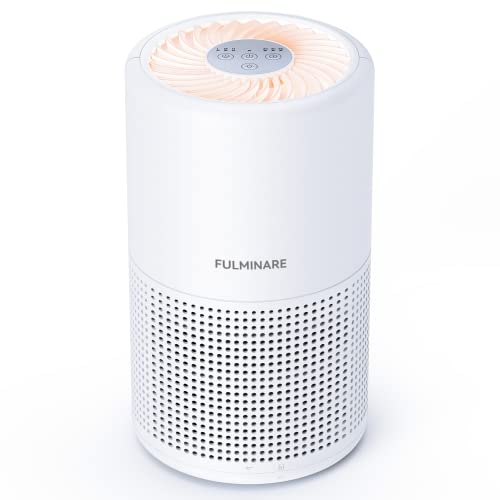
FULMINARE’s small purifier is the budget end of the category done reasonably well: an H13-grade HEPA filter (a stated grade, not just “HEPA-type” wording), a 360-degree intake so placement is forgiving, and a night light. It is still a small fan in a small box, so treat the large coverage figures in its listing with suspicion; around a desk chair, though, it moves enough air to matter.
Specs
- Filtration: H13 HEPA filter with pre-filter and carbon layer
- Size and weight: about 5.7 x 5.7 x 7.9 in, roughly 1.85 lb
- Noise: from about 20 to 24 dB on low speed
- Speeds and extras: 3 speeds, timer function, night light
- Filter life: Around 3 months of continuous use per the brand
Pros
- Stated H13 filter grade rather than vague HEPA-style language
- 360-degree intake works in a corner or against a wall
- Timer and night light are genuinely handy on a desk
Cons
- Short filter life means replacements add up over a year
- Listing coverage claims are far beyond what its airflow supports
- Build feels light and plasticky
Who it suits: Budget-conscious buyers who want a stated HEPA grade and low noise for one desk, and accept frequent filter changes.
4. Blueair Blue Pure 411

The Blue Pure 411 is the step up for people whose “desk” is really a small room they work in. It is taller than a true desktop mini, but its slim cylinder tucks beside a desk, and its CADR is several times higher than the mini units here: enough for a small office, not just a breathing zone. Instead of a sealed HEPA filter it uses HEPASilent technology, an ionizer stage paired with a particle filter, keeping it quiet and energy-efficient. A washable fabric pre-filter wraps the body.
Specs
- Filtration: HEPASilent (electrostatic plus mechanical), washable fabric pre-filter
- CADR: Around 105 CFM for dust on high speed
- Size and weight: about 8 in diameter x 16.7 in tall, roughly 3.4 lb
- Noise: from about 17 dB on low to 46 dB on high
- Power use: As low as 1.5 W on the lowest speed
Pros
- Real small-room performance, not just a personal bubble
- Extremely quiet and frugal with electricity on low
- Washable pre-filter cuts down on consumable costs
Cons
- Too tall for crowded desks; better on the floor beside one
- Not a sealed true HEPA design, which some allergy buyers insist on
- Replacement filter is a proprietary cartridge
Who it suits: Home office workers in a small dedicated room who want room-level cleaning and low noise, with floor or side-table space for it.
5. IQAir Atem Desk

The Atem Desk is the premium outlier: a Swiss-designed personal purifier from a company known for medical-grade air cleaning, built around a HyperHEPA filter rated for ultrafine particles down to 0.003 microns, far below standard HEPA’s 0.3 micron benchmark. Its pivoting outlet aims cleaned air directly at your face, exactly how a personal unit should work. The catch: unit and replacement cartridge costs sit in a different league from everything else here.
Specs
- Filtration: HyperHEPA H13 filter, rated down to 0.003 microns
- Coverage intent: Personal zone, spaces up to about 150 sq ft
- Size and weight: about 12 x 5.5 x 12 in, roughly 6 lb
- Speeds: 3 fan settings with adjustable air outlet
- Filter life: Around 12 months of typical use
Pros
- Filtration grade well beyond standard HEPA claims
- Directional outlet delivers clean air straight to your breathing zone
- Long filter life offsets some of the cartridge cost
Cons
- By far the most expensive option here, to buy and to run
- Still a personal-zone device despite the premium positioning
- Replacement cartridges are proprietary and pricey
Who it suits: Allergy-sensitive workers who spend all day at one desk and want the strongest filtration in a personal unit, budget permitting.
Comparison Table
| Model | Filter type | Airflow class | Power | Best for |
|---|---|---|---|---|
| Levoit Core Mini-P | 3-in-1 with HEPA | Personal zone, AHAM verified | Mains | Verified all-rounder for one desk |
| Pure Enrichment PureZone Mini | True HEPA | Very small personal zone | Rechargeable battery | Portability between workspaces |
| FULMINARE H13 (PU-P05) | H13 HEPA | Personal zone | Mains | Budget pick with a stated filter grade |
| Blueair Blue Pure 411 | HEPASilent | Small room | Mains | A whole small office, quietly |
| IQAir Atem Desk | HyperHEPA H13 | Personal zone, directional | Mains | Maximum filtration at one desk |
FAQ
Will a desk air purifier clean the air in my whole home office?
Realistically, no, unless the office is very small and the unit is at the larger end of this category like the Blue Pure 411. Most desk purifiers are personal-zone devices: they noticeably reduce dust and pollen in the few feet around your chair without turning over the air of a whole room. If room-wide cleaning is the goal, buy a room purifier with a CADR matched to the room size instead.
What is the difference between true HEPA and HEPA-type filters?
True HEPA is a defined standard: 99.97 percent capture at 0.3 microns. HEPA-type and HEPA-style wording carry no such guarantee, and those filters can capture substantially less of the finest particles while still handling larger dust and pet hair. If allergies drive the purchase, look for a stated grade such as true HEPA or H13, or an independently verified CADR.
How often will I need to replace the filter, and what does it cost over a year?
It varies widely. Small budget units may need a fresh filter every three months of daily use, mid-range models run about six months, and the Atem Desk cartridge is rated for roughly a year. Check the replacement filter’s price before buying the purifier, and multiply it out over a year: on the cheapest units, a year of filters can approach the cost of the machine.
Where should I place a desk air purifier for the best results?
At desk height, close to where you sit, with the intake and outlet unobstructed. A purifier on the floor under the desk mostly cleans air around your shoes, and one behind a monitor recirculates air you never breathe. Leave clearance around the intake, and run it on a low, quiet speed continuously rather than in short blasts on high.
Conclusion
A desk air purifier is a personal comfort tool, not a room-cleaning appliance, and the best purchases start from that honest expectation. For most desks, the Levoit Core Mini-P is the sensible default: verified airflow, a proper three-stage filter, and noise low enough to forget during calls. The PureZone Mini suits anyone who needs that cleaned-air bubble to move between spaces, while the FULMINARE H13 covers the budget end with a stated filter grade. If your workspace is a small room of its own, the Blue Pure 411 is the only pick here that cleans at room scale; the IQAir Atem Desk serves buyers who want filtration beyond standard HEPA at one workstation and accept the running costs. Whichever you choose, factor in replacement filters, place the unit where its air reaches you, and let it run quietly all day.
FAQ
Will a desk air purifier clean the air in my whole home office?
What is the difference between true HEPA and HEPA-type filters?
How often will I need to replace the filter, and what does it cost over a year?
Where should I place a desk air purifier for the best results?
More from Amazon
Programs that pair well with the guide above. Offers and eligibility are set by Amazon and may change.
Free shipping on eligible items, Prime Video and more. Eligible new members can start with a free trial.
Start a Prime free trialAudiobooks and podcasts to listen to on the go. Eligible new members can start with a free trial.
Try Audible freeAd-free music streaming. Eligible new subscribers can start with a free trial.
Try Music Unlimited freeA free business account with business pricing and bulk-buying tools for work, shop or home office.
Create a business accountAs an Amazon Associate we earn from qualifying purchases.

Write Your Review
No reviews yet. Be the first to share your experience!