
Key takeaways
- Set up a garage detailing corner that runs itself: precision gauges, hook rails, clamp lights, sensor bulbs, and a sturdy step stool for full service days.
A garage detailing corner earns its keep when every tool has a home and every job starts without a scavenger hunt. Most home detailers do not lack products; they lack a station. Brushes end up in a bucket, towels migrate to the workbench, cords tangle underfoot, and the one measuring tool that matters is always in a different drawer. A small desk-height corner, organized on purpose, fixes all of that, giving washing, polishing, interior work, and light service checks a single base where supplies live in plain sight.
This guide pulls together five practical picks that turn a spare stretch of garage wall into a working detailing desk. The mix is deliberate: a precision gauge for the service side of car care, a hook rail that keeps brushes, cords, and towels visible, a clamp that puts inspection light exactly where paint tells the truth, sensor bulbs that light the garage without a switch hunt, and a step stool that makes roof panels and high shelves safely reachable. Together they remove the small frictions that stretch a two-hour detail into an afternoon.
As an Amazon Associate, we earn from qualifying purchases.
OEMTOOLS Spark Plug Gap Gauge

Detailing days often share the calendar with basic service days, and that is where a gap gauge earns a permanent spot in the corner. Spark plugs drift out of specification slowly, and an engine that idles roughly or hesitates under load is frequently telling a simple story about worn electrodes and a widened gap. A wire-style gap gauge measures that gap precisely, sliding between the electrodes with light drag so the reading reflects the real clearance rather than a guess.
The OEMTOOLS gauge covers the common range of plug gaps found on everyday gasoline engines, with clearly marked wire sizes that are easy to read under garage light. Wire gauges have an advantage over flat feeler blades on used plugs: the round wire contacts the worn, slightly dished electrode surfaces more honestly, so the measurement stays trustworthy even when the plug is not brand new. The tool is small enough to live in the top drawer of the detailing desk, which is exactly where a precision habit needs to live to survive.
Used carefully, the gauge also reinforces a good workflow. Plugs come out one at a time, each gets inspected for color and deposits, the gap gets measured, and adjustments happen gently on the ground strap rather than by prying against the center electrode.
Specs
- Wire-style gauge for accurate measurement on new and worn plugs
- Covers the gap range used by most common gasoline engines
- Clearly stamped size markings on each wire
- Compact folding design that stores in a drawer or tool roll
- Suited to plug inspection during routine service sessions
SANY DAYO Jewelry Organizer 30 Hooks

The SANY DAYO organizer was designed for jewelry, but its thirty-hook rail solves a detailing problem beautifully: too many small tools with cords, loops, and handles, and nowhere visible to put them. Mounted at eye level above the detailing desk, the rail becomes a wall where wash brushes hang by their handles, polishing machine cords loop neatly instead of pooling on the floor, and microfiber towels air out on individual hooks between passes.
Visibility is the real feature here. A drawer hides disorder; a rail exposes it, and that exposure builds tidier habits. When each brush has an assigned hook, a missing brush is obvious immediately. When towels hang separated rather than stacked damp in a pile, they stay fresher and avoid picking up grit from each other. The rail also keeps cords off the concrete, where they otherwise collect dust and become tripping hazards during the constant circling that paint work requires.
Installation is simple: the rail mounts to the wall or a cabinet side with basic hardware, and its slim profile suits the narrow strip of wall most garages can spare. Thirty hooks is generous enough to dedicate zones, perhaps brushes on the left, towels in the middle, and cords on the right. That zoning turns cleanup into a quick visual checklist, which matters at the end of a long session when motivation to tidy is at its lowest.
Specs
- Thirty individual hooks for brushes, towels, cords, and small tools
- Wall-mounted rail design keeps gear visible and off the floor
- Slim profile fits narrow garage wall spaces and cabinet sides
- Open-air hanging helps towels and brushes dry between uses
- Supports zoned organization for faster cleanup checks
ULANZI Super Clamp

Paint tells the truth under a raking light held at the right angle, and the ULANZI super clamp exists to hold that light exactly there. The clamp grips desk edges, shelf lips, and cabinet frames, then holds an inspection lamp or a phone steady while both hands stay free for polishing or wiping. Swirl marks hide under soft overhead light; a clamped lamp aimed low across a panel exposes them immediately, which is the difference between finishing a panel and actually finishing it correctly.
The clamp’s value grows beyond paint inspection. It can hold a light over an engine bay during plug checks, suspend a lamp inside a wheel arch, or mount a phone playing a reference video during an unfamiliar trim removal. Its padded jaws grip firmly without chewing into painted edges or wooden desk surfaces, and the articulated mounting points let the attached light tilt until the beam lands where it is needed. One clamp, repositioned a dozen times a session, quietly replaces a tangle of tripods and propped-up flashlights.
Because it packs flat and weighs little, it can also ride along in a detailing bag for mobile jobs. Reliable, repeatable light placement is one of the cheapest upgrades in car care, and this clamp makes it repeatable.
Specs
- Heavy-duty clamp grips desks, shelves, and frames securely
- Padded jaws protect finished surfaces from marks
- Standard mounting points fit lights, phones, and small cameras
- Adjustable angles for precise inspection-light placement
- Compact, portable design suited to garage and mobile use
HEKEE Dusk to Dawn Bulbs A19

Garages are notorious for bad light-switch geography: the switch is never near the door actually used, and hands full of buckets do not go hunting for it. HEKEE dusk to dawn bulbs solve the problem with a built-in light sensor that turns the bulb on when ambient light falls and off when daylight returns. The detailing corner lights itself on gray mornings, at dusk, and during evening sessions, with no switch and no smart-home setup required.
The A19 format fits the fixtures garages already have: bare socket pendants, utility lamps, and standard ceiling bases. Consistent, automatic light changes the character of the corner.
Placement deserves a moment of thought. The sensor reads the light around the bulb itself, so the fixture should sit where daylight reaches it during the day; a bulb buried in a fully dark enclosure may stay on longer than intended. In an open garage fixture near a window or a frequently opened door, behavior is predictable. Paired with the clamped inspection light for close paint work, these bulbs handle the broad ambient layer, giving the corner a two-tier lighting setup.
Specs
- Built-in dusk to dawn sensor for automatic on and off operation
- Standard A19 shape fits common garage sockets and fixtures
- No timers, apps, or smart-home equipment required
- Provides steady ambient light for the detailing corner
- Best placed where daylight can reach the sensor during the day
Rubbermaid 2-Step Plastic Step Stool
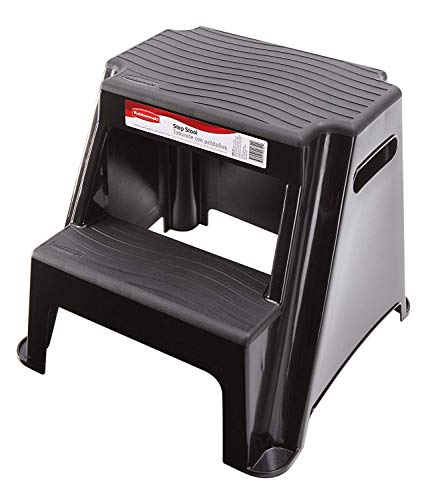
Every garage has a zone that hands cannot quite reach: the center of an SUV roof, the top shelf where the compound bottles live, the upper wall hooks for the extension cord. The Rubbermaid two-step stool closes that gap safely. Two steps put most adults at a comfortable working height for roof washing, drying, and polishing, turning an overstretched, tiptoe task into a stable, square-on one.
The stool’s plastic construction suits garage duty. It shrugs off water, soap, and the occasional splash of wheel cleaner, and it rinses clean in seconds. It is light enough to carry one-handed around the car, which encourages actually using it instead of improvising with an overturned bucket, a habit that ends ankles. When the session ends, the stool tucks under the detailing desk or against the wall, out of the walkway.
Beyond roof work, the stool earns its place during organization itself. Mounting the hook rail, placing the sensor bulbs, and arranging the top shelf all happen at installation height, and the same stool supports every later rearrangement. Simple, sturdy, and endlessly borrowed, a good step stool is the quiet backbone of a garage that stays organized.
Specs
- Two-step design for safe reach to roofs and high shelves
- Lightweight plastic construction that rinses clean easily
- Stable footing for two-handed washing and polishing work
- Compact footprint stores under a desk or against a wall
- Suited to garage, household, and installation tasks alike
How to Choose
Start with the wall, not the products. A detailing corner needs roughly a desk-width of clear wall, one reachable outlet, and enough floor space to stand back and look at a panel. Measure that footprint first, then assign the rail to the wall at eye level, the work surface below it for products and pads, and the stool storage underneath.
Light deserves the next decision, because it shapes every other task. Plan for two layers: ambient light that turns on by itself, like sensor bulbs, for general work, and a directional inspection light on a clamp for paint evaluation. Judge any lighting choice by a simple test: can swirl marks be seen on a dark panel without moving the car? If not, the corner will produce hopeful detailing rather than verified results.
Organization choices should favor visibility over capacity. Open hooks, clear zones, and one assigned home per tool outperform deep bins for the small, frequently used items that dominate detailing. Save drawers and closed storage for chemicals and bulk towels. Finally, fold basic service tools into the corner deliberately. A gap gauge beside the brushes turns the corner into a complete car-care station, so the car gets looked after in one visit rather than three.
FAQ
How much space does a garage detailing corner need?
A single desk-width stretch of wall, around four to six feet, is enough for a functional corner. The rail, a small work surface, and stool storage underneath cover the essentials. What matters more than raw size is that the space is dedicated: gear that must be unpacked before every session rarely gets used, while a standing corner invites frequent, shorter sessions.
Why check spark plug gaps during a detailing session?
Because the car is already stationary, clean, and being looked at closely. Plug inspection takes only a few extra minutes and catches wear that affects idle quality, throttle response, and fuel use. A gap gauge makes the check objective rather than guesswork, and pairing light service checks with appearance care builds one sustainable routine instead of two competing ones.
Where should the inspection light be clamped for paint checks?
Clamp it so the beam rakes low across the panel rather than shining straight down at it. A side angle reveals swirls, holograms, and remaining haze that overhead light hides. Moving the clamp as the work moves keeps every panel honestly lit.
Do dusk to dawn bulbs work in a garage with no windows?
They work, but placement matters. The sensor responds to light around the bulb, so in a fully dark garage the bulb may remain on whenever power is supplied. That can still serve as an always-ready light, but the automatic benefit is strongest where some daylight reaches the fixture. In windowless spaces, a switched fixture near the door may be the simpler choice.
Final Verdict
A garage detailing corner succeeds on systems, not on any single product, and these five picks divide the work cleanly. The OEMTOOLS gap gauge anchors the service side with a precise measuring habit. The SANY DAYO thirty-hook rail keeps brushes, cords, and towels visible, dry, and accounted for. The ULANZI super clamp puts inspection light at the revealing angle paint demands. HEKEE dusk to dawn bulbs make the corner light itself, and the Rubbermaid step stool extends safe reach to roofs and high shelves. Together they form a compact station where a full service day, from wash to plug check, runs in order and cleans up in minutes.
Product and ASIN Reference
| Product | ASIN |
|---|---|
| OEMTOOLS Spark Plug Gap Gauge | B08DL89DWW |
| SANY DAYO Jewelry Organizer 30 Hooks | B07QFZSVQW |
| ULANZI Super Clamp | B09C882D4M |
| HEKEE Dusk to Dawn Bulbs A19 | B07HGZMYZ4 |
| Rubbermaid 2-Step Plastic Step Stool | B004Q0I2RS |
FAQ
How much space does a garage detailing corner need?
Why check spark plug gaps during a detailing session?
Where should the inspection light be clamped for paint checks?
Do dusk to dawn bulbs work in a garage with no windows?
More from Amazon
Programs that pair well with the guide above. Offers and eligibility are set by Amazon and may change.
Free shipping on eligible items, Prime Video and more. Eligible new members can start with a free trial.
Start a Prime free trialAudiobooks and podcasts to listen to on the go. Eligible new members can start with a free trial.
Try Audible freeAd-free music streaming. Eligible new subscribers can start with a free trial.
Try Music Unlimited freeA free business account with business pricing and bulk-buying tools for work, shop or home office.
Create a business accountAs an Amazon Associate we earn from qualifying purchases.










Write Your Review
No reviews yet. Be the first to share your experience!